

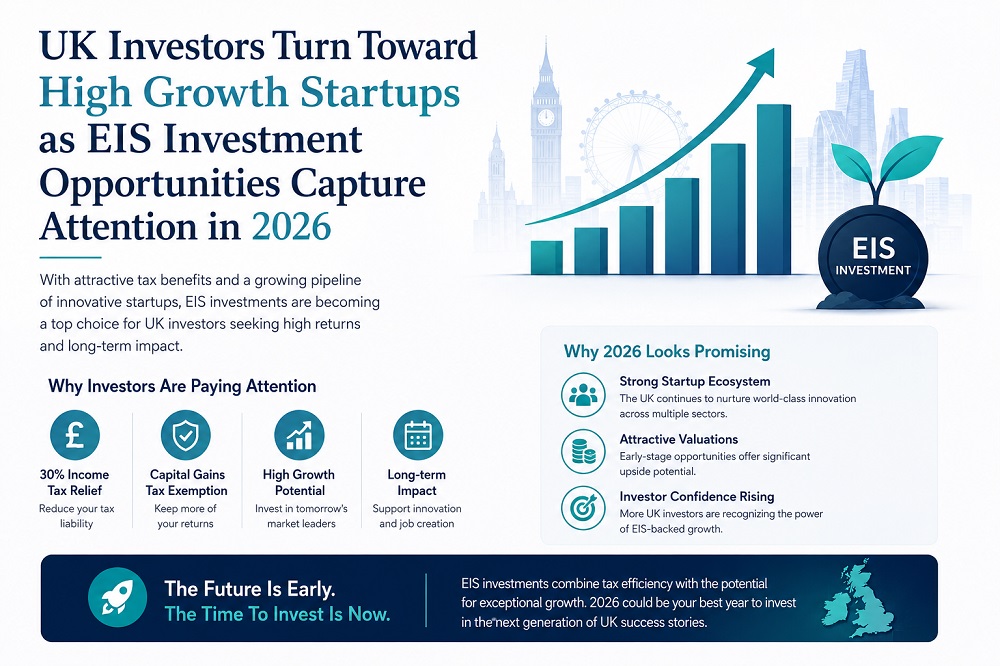
The UK startup funding market is entering a new phase in 2026, with EIS investment opportunities increasingly drawing the attention of investors seeking growth, diversification and tax efficiency in an uncertain economic environment. While traditional investment markets continue to face volatility and changing expectations around returns, early stage businesses supported through the Enterprise Investment Scheme are moving back into focus.
Across the private investment landscape, EIS investment opportunities are becoming part of a wider discussion about how capital can be deployed more strategically into sectors shaping the future economy. Artificial intelligence, climate innovation, healthcare technology and specialist software businesses are attracting growing interest, helping place EIS firmly back into financial headlines.
Rising demand reflects changing investor priorities
Recent investment data illustrates why the conversation around EIS is intensifying. According to HM Revenue and Customs, companies raised approximately £1.575 billion through EIS during the 2023 to 2024 tax year, with close to 3,800 businesses securing funding. Although this represented a reduction compared with the previous year, many analysts believe the figures point toward a healthier and more disciplined investment environment rather than weakening demand.
This shift matters because investors are becoming increasingly selective.
During previous years of abundant capital, early stage funding often moved quickly toward businesses with ambitious growth narratives but limited commercial evidence. In 2026, investor expectations have changed considerably. Capital is still available, but it is flowing more carefully toward businesses that demonstrate clear market need, capable leadership and credible pathways to scale.
This more measured approach is helping reshape the perception of EIS investing.
Rather than being viewed solely as a tax efficient investment strategy, EIS is increasingly associated with quality deal sourcing and participation in sectors expected to drive long term economic growth. Investors are showing greater willingness to undertake detailed due diligence and longer holding periods, reflecting a more mature attitude toward startup investment.
Another important factor driving interest is portfolio diversification.
Many private investors are reassessing their exposure to public markets following several years of volatility and changing interest rate conditions. Property markets, once viewed as a dependable route to growth, are also facing evolving sentiment and regulatory pressures. Against this backdrop, EIS backed investments offer access to private businesses operating in sectors often unavailable through traditional listed markets.
Technology and innovation place EIS at the centre of market headlines
Artificial intelligence remains one of the most powerful forces behind current investor activity.
Across the UK, AI focused startups are securing attention from angel investors, venture funds and specialist investment groups seeking exposure to rapidly developing technologies. Yet unlike previous technology cycles, investor enthusiasm is now accompanied by more rigorous commercial scrutiny.
Businesses are being evaluated not simply on technological innovation but on practical application, customer demand and sustainable revenue generation.
This environment is creating stronger quality thresholds for EIS eligible companies.
Founders seeking investment are increasingly aware that securing capital requires more than a compelling concept. Investors are demanding evidence of market traction, realistic financial forecasting and management teams capable of navigating growth challenges. As a result, businesses entering the EIS ecosystem are often better prepared than their counterparts from earlier funding cycles.
Healthcare and life sciences are also contributing to rising investor interest.
An ageing population, digital healthcare adoption and advances in medical technology are creating substantial demand for innovation. Startups operating within diagnostics, digital health platforms and specialist treatment technologies are benefiting from increased investor engagement, particularly where scalable intellectual property and commercial partnerships are evident.
Clean technology is another sector helping push EIS into national headlines.
The transition toward lower carbon infrastructure and energy efficiency continues to attract policy support and private investment alike. Businesses developing energy solutions, environmental technologies and sustainable industrial systems are increasingly viewed as long term growth opportunities capable of delivering both financial and societal value.
Regional investment growth creates broader opportunity
While London remains a dominant centre for venture investment, one of the most notable developments in 2026 is the expansion of startup ecosystems across regional cities.
Bristol, Manchester, Leeds, Edinburgh and Birmingham are attracting growing volumes of entrepreneurial activity supported by universities, innovation clusters and experienced founders building businesses outside traditional financial districts. This regional growth is widening the pool of available opportunities and creating stronger local investment networks.
For investors, this trend is significant.
Regional businesses often present access to specialised talent and emerging sectors while competing in less saturated funding environments than central London. As a result, investors are discovering opportunities that may previously have been overlooked.
This broader geographic spread also strengthens the resilience of the UK innovation economy.
Rather than concentrating startup success within a limited number of postcodes, investment is increasingly supporting businesses capable of generating skilled employment and economic value across multiple regions.
The rise of regional innovation has therefore become an important part of the EIS narrative and a further reason why the scheme is generating renewed media coverage.
Why EIS investment opportunities are dominating financial discussion
Perhaps the biggest reason EIS continues to capture headlines lies in the scale of its long term impact.
Since the scheme was introduced in 1994, more than £32 billion has been invested into over 56,000 companies through EIS structures. These figures demonstrate the scheme’s enduring influence and explain why it remains central to conversations around entrepreneurship and economic growth.
However the current news cycle is not simply about historical success.
The headlines surrounding EIS investment today reflect a combination of economic uncertainty, evolving investor behaviour and rapid technological change. Investors are searching for growth opportunities that offer both upside potential and structured support through tax relief. Founders are seeking capital in a more selective market. Policymakers continue to view entrepreneurial growth as essential to long term competitiveness.
This convergence of priorities is placing EIS investment opportunities at the centre of market discussion.
Importantly, the conversation has evolved beyond tax efficiency alone. Investors increasingly want access to businesses capable of generating meaningful innovation and sustainable growth over the long term. This shift is creating a more informed and sophisticated investment culture where strategic thinking carries greater weight than short term speculation.
Looking ahead, many analysts believe EIS will continue to play a defining role in how private capital enters the UK startup market. While investment conditions may fluctuate and sectors may evolve, demand for high quality early stage businesses remains strong.
For investors willing to look beyond traditional asset classes and participate in the next generation of British innovation, EIS investment opportunities are likely to remain firmly in the spotlight throughout 2026 and beyond.